
 English
 عربى
عربى Español
 русский
 中文简体
中文简体






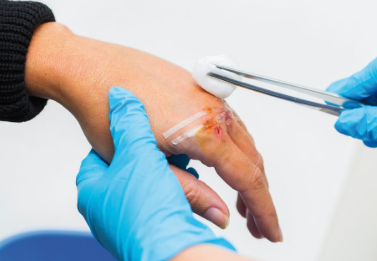
Many patients and their families become anxious when they see bleeding during wound debridement, worrying that there has been a problem with the procedure or that the wound has worsened. However, in clinical judgment of wound care, bleeding during debridement needs to be differentiated into different situations. Some bleeding is actually evidence of tissue viability. Necrotic tissue has no blood supply and will not bleed when grasped with forceps or debrided with sharp instruments, while healthy granulation tissue is rich in capillaries and will bleed even with slight touch. Therefore, bleeding itself is not a bad thing, but it cannot be simply assumed that every instance of bleeding is a sign of wound healing. It is also necessary to observe the color, amount, source of bleeding, and the condition of the wound base after bleeding.
Why is bleeding during debridement sometimes considered a sign that the tissue is still alive?
A tissue's blood supply is a direct reflection of its healing potential. Tissue without a blood supply appears grayish-white or dark brown during debridement; cutting it feels like shaving off a block of wax, with no blood oozing out. Such tissue will not develop granulation tissue regardless of medication. Conversely, bright red granulation tissue is covered with newly formed capillaries. These capillaries have thin, fragile walls that rupture and bleed easily with gentle scraping by debridement instruments. Bleeding indicates that this layer of tissue has blood perfusion, oxygen and nutrients are being transported, and fibroblasts and endothelial cells are actively functioning. From a debridement perspective, the goal is to remove non-bleeding necrotic tissue while preserving as much healthy granulation tissue as possible. A crucial indicator of whether necrotic tissue has been adequately removed is the appearance of uniform pinpoint bleeding at the base of the wound. This standard is called the debridement endpoint in surgical debridement, meaning that reaching the point where bleeding healthy tissue is visible indicates that the active layer has been reached.
What kinds of bleeding should raise suspicion?
Bleeding related to wound debridement needs to be assessed for risks from several perspectives. Arterial bleeding is characterized by bright red blood gushing out in a pulsating, jet-like manner. This type of bleeding will not stop on its own and requires immediate pressure and prompt medical attention. Venous bleeding is dark red in color, flows out at a relatively slow rate, but can be quite heavy; continuous venous oozing can also cause significant blood loss. Capillary oozing from the wound base after debridement is normal, appearing as fine, pinpoint oozing that can be stopped by gentle pressure with saline-soaked gauze for a few minutes. It is important to be alert if bleeding is found to originate from a deep cavity or if the amount of bleeding significantly exceeds the scope of the debridement procedure. For example, if only a small amount of superficial necrotic tissue is removed but continuous bright red oozing occurs, it suggests that the procedure may have damaged larger subcutaneous blood vessels. Another noteworthy situation is dark red bleeding with a large flow that does not decrease with pressure, accompanied by rapid swelling of the surrounding tissue. This suggests hematoma formation or deep vascular rupture. This type of bleeding may initially be masked by the dressing, requiring observation of limb swelling and changes in skin tension.
How to manage persistent bleeding after wound cleaning at home?
If bleeding continues after wound cleaning at home, the first step is to stop further procedures. Fold sterile gauze into a thick pad and place it directly over the bleeding site, applying continuous, even pressure with your palm for at least 10-15 minutes. Do not repeatedly lift the gauze to check, as this will disrupt the newly formed blood clot. While applying pressure, elevate the affected limb above heart level to reduce local arterial perfusion pressure using gravity. If bleeding continues to seep through the gauze after 15 minutes, do not remove the original gauze; instead, add another thicker layer of gauze on top to continue applying pressure, increasing the overall thickness and effectiveness. Simultaneously contact medical personnel or go to the nearest medical facility if pressure persists. Rinsing with cold water or applying ice to stop bleeding after wound cleaning is not suitable for this type of wound. While low temperatures can constrict blood vessels, they can also damage the already fragile granulation tissue, affecting subsequent healing. Do not wipe away any remaining blood clots after bleeding stops. The blood clot itself provides temporary protection to the wound and will naturally loosen and fall off during the next dressing change. The depth and extent of debridement should be assessed by a professional, especially for diabetic foot and lower extremity ischemic wounds. Aggressive procedures may remove granulation tissue that is being irrigated, causing bleeding and wound enlargement. A conservative, gradual debridement strategy is more suitable for these types of wounds.
After cleaning, the wound appears larger. Is this normal?
The wound area after initial standardized debridement is often larger than the visible wound area before debridement. This is because defects previously covered and obscured by necrotic tissue are exposed after debridement, and it does not indicate wound deterioration. Necrotic tissue acts like a veil covering the true wound floor; only after removal does the underlying cavities and deep defects become apparent. Subsequent area measurements should be restarted from the debridement base boundary. The significance of bleeding during debridement should be judged in conjunction with the color and texture of the wound base. If, after debridement, the base presents a uniform, reddish, granular granulation tissue with fine, pinpoint bleeding that stops spontaneously upon pressure, the wound is at an ideal starting point for healing. Bleeding with each debridement is not necessarily a bad thing, but persistent bleeding or bleeding originating from deep structures that are difficult to determine requires professional assessment of the debridement depth and vascular damage. The assessment of bleeding should always be considered in conjunction with the condition of the wound base, rather than being reassured or panicked by bleeding in isolation . For more information on Innomed® Silicone Foam Dressing, refer to the Previous Articles. If you have customized needs, you are welcome to contact us; You Wholeheartedly. At long-term medical, we transform this data by innovating and developing products that make life easier for those who need loving care.
Editor: kiki Jia


