
 English
 عربى
عربى Español
 русский
 中文简体
中文简体






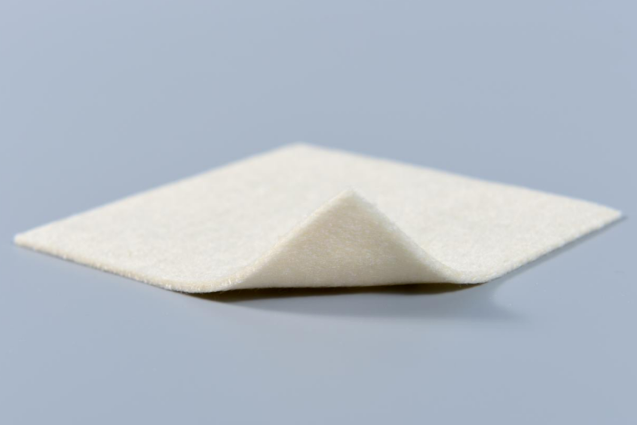
Many people who use alginate dressings notice that when a wound is bleeding, applying this dressing quickly stops the bleeding, with significantly better results than ordinary gauze. Alginate dressings do indeed have a hemostatic effect, and this effect is not auxiliary but one of its inherent properties. The product instructions also clearly state that alginate dressings promote hemostasis when in contact with bleeding wounds.
Hemostasis relies on calcium ions
The core of the hemostatic mechanism of alginate dressings lies in calcium ions. Alginate is a polysaccharide extracted from brown algae. In industrial production, it is made into calcium alginate salt, which means that calcium ions replace the sodium ions on alginate. When this material comes into contact with blood or wound exudate, the sodium ions in the liquid exchange with the calcium ions in the dressing. The calcium ions are released, and the alginate absorbs the liquid to form a gel.
Released calcium ions play a crucial role in hemostasis. Calcium ions are involved in multiple steps of the coagulation cascade, acting as coagulation factor IV and playing a vital role in the hemostatic phase. When local calcium ion concentration increases, platelets are activated, the conversion of prothrombin to thrombin accelerates, and fibrinogen polymerizes into a fibrin network more quickly, resulting in a denser and more stable blood clot.
Simply put, alginate dressings stop bleeding not through physical pressure, but by actively participating in the coagulation reaction, providing additional calcium ions to the wound, and accelerating the body's own coagulation process.
How effective is it at stopping bleeding?
A 2025 study published in the Journal of Surgical Research compared the hemostatic effects of sodium calcium alginate with other hemostatic materials. In a standard porcine liver wound model, sodium calcium alginate achieved a 90% hemostatic success rate at 2 minutes after application, while microporous starch achieved only 0% and oxidized cellulose only 50%; at 5 minutes, sodium calcium alginate achieved 86.7%, while microporous starch and oxidized cellulose remained at 0% and 43.3%, respectively.
Compared to biologically derived fibrin glue, sodium calcium alginate achieved a hemostatic success rate of 94.1% at 2 minutes, compared to 50.0% for fibrin glue, a significant difference. By 5 minutes, the difference narrowed to 94.1% and 85.3%, respectively. Alginate dressings have a faster onset of action, which is valuable in acute bleeding scenarios.
In the management of chronic wounds such as diabetic foot, calcium alginate sodium dressings also have a clear hemostatic effect. A clinical study on wounds caused by type 2 diabetic lower extremity vascular disease showed that the average hemostasis time for patients using calcium alginate sodium dressings was 2.98 minutes, compared to 3.35 minutes for the control group using ordinary dressings.
Will calcium ion release affect healing?
Calcium ions continue to play a role after hemostasis. Studies have shown that calcium alginate dressings release calcium ions in the early acute phase to promote hemostasis, and in the later stages of skin repair, especially during the recovery period, calcium ions also affect the intracellular environment and participate in keratinocyte differentiation and proliferation.
However, alginate dressings are best suited for wounds with moderate to heavy exudate and a small amount of bleeding. If there is arterial spurting bleeding or a ruptured large blood vessel, alginate dressings are ineffective and require surgical ligation or compression to stop the bleeding, followed by prompt medical attention. Furthermore, alginate dressings are absorbent; once saturated, they lose their hemostatic and drainage properties and need to be changed promptly. Generally, wounds with heavy exudate should be changed daily, and this can be extended to every two days once the exudate decreases.
In summary, alginate dressings achieve hemostasis through the participation of calcium ions in the coagulation process. This is a physicochemical mechanism, independent of the body's own coagulation function, making it suitable for patients with normal or mildly abnormal coagulation function. This is the fundamental difference between alginate dressings and other physical compression hemostatic materials such as ordinary gauze and gelatin sponges. For more information on Innomed® Alginate Dressing,refer to the Previous Articles. If you have customized needs, you are welcome to contact us; You Wholeheartedly. At long-term medical, we transform this data by innovating and developing products that make life easier for those who need loving care.
Editor: kiki Jia


