
 English
 عربى
عربى Español
 русский
 中文简体
中文简体






Many people carry acne patches in their bags, applying one whenever a pimple appears. But when is the best time to apply them, and is applying them during the day or before bed the same? This is a question worth clarifying. The answer is yes, there is a difference, and a significant one at that.
How Acne Patches Work
To understand when is the best time to apply acne patches, we first need to know how they work. Acne patches originated from hydrocolloid dressings, a medical material used for open wounds. Their core functions are twofold: first, absorption—they absorb tissue fluid and purulent secretions from the wound, drawing these fluids into the dressing to form a white, gel-like substance; second, isolation—they create a sealed environment on the wound surface, protecting it from external bacteria, dust, makeup, and contact with hands, preventing secondary infection.
However, acne patches have an inherent limitation: they do not contain any medication and only rely on physical absorption. Therefore, they are suitable for a limited range of acne types, primarily ruptured, open pustules or squeezed pimples. For an unbroken, closed comedone or a red, swollen pimple without an opening, applying an acne patch is basically useless because the absorbent material in the patch cannot reach the pimple's contents.
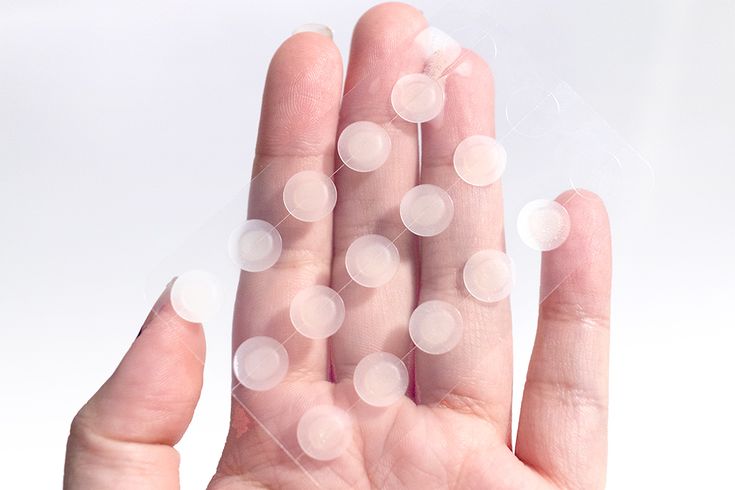
To apply it before bed?
The biggest advantage of applying pimple patches before bed is the ample time. It typically takes several hours for a pimple to rupture and for the secretions to be absorbed. If you apply them during the day, you might need to go out, change the patch, or it might get rubbed off before the secretions are completely absorbed. Eight hours of continuous sleep at night provides the complete cycle for the pimple patch to work, allowing it to fully absorb the exudate and reducing the hassle of frequent changes.
Another advantage is that no one will be watching you at night, so you don't have to worry about appearance. Acne patches, after all, do contain something on your face; even though they're transparent and not very noticeable, they're still visible up close. It doesn't matter if you sleep at night; you can apply them tightly, and when you remove them the next morning, most of the secretions will have been absorbed.
Another easily overlooked point is that you won't touch your face while sleeping. Many people unconsciously touch or pick at their pimples during the day, which is actually a major reason for recurring infections and slow healing. Applying pimple patches physically blocks finger contact, effectively providing eight hours of protection during sleep.
Suitable scenarios for daytime application
Applying pimple patches during the day isn't necessarily bad, but the purpose is different. Daytime application is primarily for protection, not absorption. If a pimple has broken but hasn't fully healed, applying a patch during the day can isolate it from makeup, airborne dust, and prevent you from unconsciously touching it. Especially for those who wear makeup, applying foundation directly to pimples can easily clog pores; applying a pimple patch before makeup is like adding a protective film to the pimple.
However, there are a few problems with using them during the day. First, there's the aesthetic issue. Although transparent patches aren't very noticeable, they're still visible under strong light or during close-up social interactions. Second, the adhesion time is insufficient. During the day, with more activity, sweating, and facial expressions, the patches are prone to lifting edges or falling off. Third, they need to be changed frequently. If there's a lot of acne secretion, the patch will become white and saturated after a few hours. If you don't change it at this point, the dampness may worsen the local problem.
Are there any special products that differentiate between daytime and nighttime use?
Some brands do offer acne patches for day and night use. Day patches are usually thinner and more transparent, emphasizing invisibility for convenient daytime use in social situations. Night patches are thicker and have stronger absorption capabilities, some even containing ingredients like tea tree oil, focusing on nighttime repair. However, they essentially work on the same principle: using hydrocolloid materials to absorb water and oil; the differences lie only in thickness and added ingredients. Using the regular patches for morning and evening is perfectly fine; there's no need to buy two sets.
Precautions for use
Before applying an acne patch, clean your skin thoroughly. It's best to gently disinfect the skin around the pimple with alcohol or iodine to prevent bacteria from being trapped inside. If the pimple hasn't broken open, do not force it open before applying the patch, especially if it's in the "danger triangle" area of the face, as squeezing it can lead to infection and spread. Acne patches are only suitable for occasional breakouts of a few pimples. If you have pimples all over your face or experience recurring breakouts, patches won't solve the underlying problem, and you should see a dermatologist.
Another issue is breathability. Acne patches create a sealed environment, but Propionibacterium acnes, which causes acne, is an anaerobic bacterium that multiplies faster in an oxygen-deficient environment. Therefore, if acne patches make your skin redder and more swollen after use, it means they may not be suitable or you have been using them for too long, and you should stop using them.
Sleep patches are ideal for primary treatment, allowing for full absorption of secretions during sleep without worrying about appearance. Day patches are suitable for supplementary protection, primarily isolating makeup and pollutants to prevent secondary infection. The two are not mutually exclusive; you can use the daytime patch for protection and the nighttime patch for repair, or use only the nighttime patch and let your skin breathe during the day. It depends on the stage of your acne and your plans for the day. For more information on Innomed® Acne Plaster, refer to the Previous Articles. If you have customized needs, you are welcome to contact us; You Wholeheartedly. At long-term medical, we transform this data by innovating and developing products that make life easier for those who need loving care.
Editor: kiki Jia


