
 English
 عربى
عربى Español
 русский
 中文简体
中文简体





For many people who have undergone stoma surgery, the most troublesome problem isn't the stoma itself, but the skin around it. This skin is constantly in contact with the stoma baseplate and excrement, making redness, itching, chafing, and oozing almost commonplace. Statistics show that over one-third of stoma patients experience peristomy. If not treated properly, this not only causes discomfort but also prevents the ostomy bag from adhering properly, further exacerbating the problem with leakage. However, most cases of peristomy dermatitis are preventable and controllable. The key is to identify what caused the skin injury and then treat it accordingly.
Why is the skin around the stoma so prone to problems?
The skin around the stoma faces multiple challenges daily. Digestive enzymes in excrement are highly corrosive, especially the fluid from a small intestinal stoma, which contains active trypsin and lipase. These enzymes, normally used to digest food, directly break down the stratum corneum upon contact with the skin. Bile salts in feces also irritate the skin, causing chemical reactions. Once the outermost barrier of the skin is damaged, moisture loss accelerates, leading to dryness and fragility, making it easier for bacteria and fungi to grow. Besides chemical irritation, there is also physical damage. The adhesive on the stoma baseplate is repeatedly peeled off and reapplied, pulling down keratinocytes from the skin's surface, eventually causing thinning and redness. Incorrectly cut baseplate size is also a common problem; if cut too large, excrement seeps into the area around the opening and corrodes the skin; if cut too small, the edge of the baseplate presses against the stoma root, causing ulcers. Some people are allergic to the adhesive or the baseplate material itself. Although the proportion is low, when an allergic reaction occurs, the affected area becomes red and itchy, and conventional methods are ineffective in controlling the reaction. Another easily overlooked situation is fungal infection. The warm and moist environment under the stoma base is an ideal environment for Candida to grow. After infection, the skin will have a red papule with white scaling at the edges, and it will be very itchy.
How can I determine the cause of dermatitis?
The first step in treating peristaltic dermatitis is not to rush into medication, but to determine the type of skin problem. Chemical irritation-induced dermatitis typically presents as a large area of redness within the stoma-covered area, with a burning or stinging sensation on the skin surface. The borders are relatively clear, precisely around the edge where excrement comes into contact. Skin problems caused by mechanical damage are often most noticeable at the edges of the stoma or in areas frequently torn. The skin appears thin and shiny, with scattered red dots or tiny cracks. Allergic reactions are not necessarily confined to the area directly under the stoma; sometimes they extend beyond the edges. The skin is bright red, significantly swollen, and itching is more prominent than pain. Fungal infections present with clearly defined satellite lesions, meaning a patch of red rash with a lighter-colored central area and a ring of small red papules spreading outwards. In many cases, these causes are not isolated; chemical irritation may have first damaged the skin barrier, allowing fungi to grow, or repeated tearing may have thinned the skin, reducing its tolerance to adhesives. Identifying the primary cause is crucial for choosing the right treatment.
What are the solutions for different types of dermatitis?
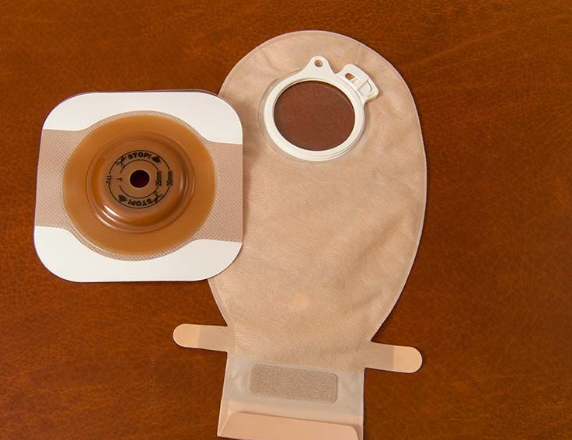
If the chemical irritation dermatitis is caused by leakage of excrement, the most crucial measure is not applying ointment, but checking the seal of the stoma baseplate. If excrement can contact the skin, it indicates a gap between the baseplate and the skin. It's necessary to measure not only the stoma diameter but also the shape of the stoma root. Some people have a depression between the stoma root and the abdominal wall skin, called the parastomal groove, where excrement easily flows out. In this case, a regular flat baseplate is insufficient for sealing; a convex baseplate or a leak-proof ring is needed. A leak-proof ring is a moldable dressing; it's shaped into a strip and placed around the stoma root. It absorbs small amounts of excretion and expands to fill the depression before the flat baseplate is applied. After using a convex baseplate or leak-proof ring, excrement will flow directly into the ostomy bag instead of accumulating on the skin, and the dermatitis will naturally subside. For skin care, you can use stoma care powder. First, clean the surrounding skin, gently pat it dry, sprinkle a thin layer of care powder to absorb the exudate, then sweep away the excess powder, and then spray on a skin protectant. After the protectant dries, it will form a transparent protective film, separating the skin from the excrement.
If the damage is caused by repeated tearing, the frequency of baseplate replacement and the tearing technique need to be adjusted. Many patients worry that the baseplate won't stick properly and peel it off every day to check, but this is actually harmful. Each tear removes a layer of keratinocytes, making the skin thinner and thinner. Modern stoma baseplates are designed to be worn for three to seven days; as long as there is no leakage, do not replace them prematurely. When peeling, use an adhesive remover spray or wipe. Spray it on the edges and wait a few seconds; the adhesive will lose its stickiness, and it can be easily peeled off without any pain. Adhesive removers contain silicone solvents, which are non-irritating to the skin. After peeling, wash with warm water; do not use alcohol or soap, and do not rub vigorously.
For more information on Innomed®Skin Protective Paste, refer to the Previous Articles. If you have customized needs, you are welcome to contact us; You Wholeheartedly. At long-term medical, we transform this data by innovating and developing products that make life easier for those who need loving care.
Editor: kiki Jia


