
 English
 عربى
عربى Español
 русский
 中文简体
中文简体






Many people buy good-looking functional wound dressings, apply them to their wounds at home, and that's it. The next day, they find the dressing has curled up at the edges, and the surrounding skin is red and irritated from the tape. This isn't due to poor quality dressings, but rather a problem with the application method. Learning a few cutting and securing techniques can ensure the dressing stays in its proper place.
How can I apply the adhesive to joints and bony prominences so that it doesn't fall off?
The skin on areas like the knees, elbows, and heels is uneven and changes shape with movement. Simply patting a square dressing on directly will cause it to curl up with any movement. The solution is to cut it into smaller pieces. First, cut the dressing radially, making several slits from the edge towards the center. When applying it, first place the center against the apex of the joint, then smooth each small wing outwards. After applying, it's essential to secure it with an elastic bandage, wrapping it from the distal end to the proximal end, ensuring you can easily insert a finger. After applying the dressing to the heel, put on a clean cotton sock. For the elbow, use an elastic mesh sleeve; this is easier than using a bandage.
How to wrap the ears and fingertips?
Ear wounds are the most difficult to treat. Cut the dressing into a circle slightly larger than the wound, and make small cuts every 0.5 centimeters along one edge. First, secure the uncut side to the back of the ear, then fold the small cut ends one by one towards the front of the ear, each end covering an area independently. For fingertips, the entire fingertip needs to be covered. Cut the dressing into a trapezoidal shape, wrap the narrow end around the tip of the fingertip, fold the sides towards the nail to overlap, and finally secure it with tape around the base of the finger. For wounds between the fingers, cut the dressing into a bow shape, tuck the narrow part into the gap between the fingers, and apply the wider part to the sides of the two fingers.
Are there any special application methods for the sacrum and coccyx?
The sacrum and coccyx are high-risk areas for pressure ulcers in people who are bedridden for extended periods. Rotate the square dressing 45 degrees to create a rhombus shape, with the two pointed corners aligned with the lower back and gluteal cleft, respectively. This way, when the patient sits up, the longitudinal stretch of the skin is concentrated in the center of the rhombus, reducing the likelihood of the edges lifting. After applying the dressing, seal the edges with breathable wide adhesive tape. For patients with urinary or fecal incontinence, add an additional layer of transparent film to completely cover the dressing, and write the application date on the edge with a marker to easily identify when it needs changing.
How can you stick and peel something without hurting your skin?
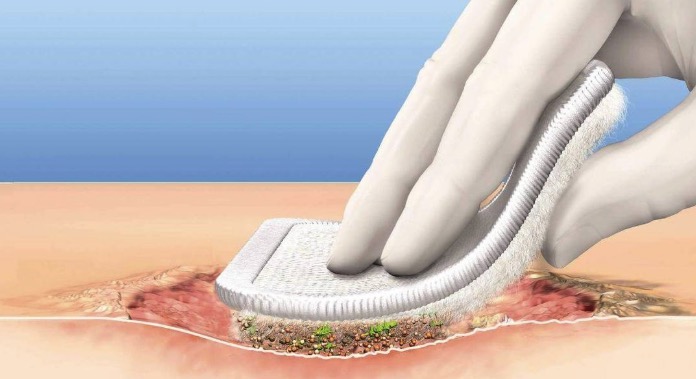
Many people apply dressings by pulling the adhesive tape tightly onto the skin, which can actually cause tension blisters. The correct way is to first lay the dressing flat on the skin without stretching it, and then use your fingers to gently press outwards from the center to remove air bubbles. When removing a dressing, avoid suddenly ripping it off. First, hold the edge of the dressing against the skin with your fingers, and with your other hand, pinch one corner of the dressing and slowly peel it off parallel to the skin. If you feel resistance halfway through, cover the adhesion area with gauze soaked in saline solution and wait two or three minutes before peeling it off completely. For patients requiring frequent dressing changes, first spray a layer of skin protectant on the normal skin around the wound, then apply the dressing over the protective film. This way, even after dozens of dressing changes, the surrounding skin won't become damaged.
For more information on Innomed®Hydrocolloid Dressing, refer to the Previous Articles. If you have customized needs, you are welcome to contact us; You Wholeheartedly. At long-term medical, we transform this data by innovating and developing products that make life easier for those who need loving care.
Editor: kiki Jia


