
 English
 عربى
عربى Español
 русский
 中文简体
中文简体






When joints like the elbows, knees, and ankles are frequently injured, changing dressings becomes a particularly troublesome process. The dressing may appear smooth initially, but with every bend and stretch of the arm or leg, the edges curl up and clump together, causing fluid to leak out and stain clothing, while the wound remains exposed to air. The root of this problem lies in the fact that the backing material and adhesive layer design of ordinary dressings do not take into account the extensibility of skin around joints. During joint movement, the skin stretches, often exceeding 30%. If the dressing itself cannot stretch synchronously, shear forces will be generated between the skin and the dressing. This force repeatedly pulls on the interface between the adhesive layer and the skin, eventually causing the dressing to detach from the edges. Therefore, the failure of dressings at joints is essentially due to a problem with the mechanical fit between the dressing and the skin, rather than simply insufficient adhesiveness.
Edge-pressed design and regular dressings?
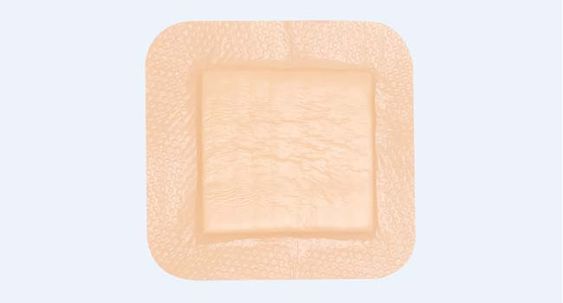
The concept of edge-sealing design refers to the creation of a specially designed, sufficiently wide outer border around the absorbent pad of the dressing's main absorbent layer, with independently optimized material properties. Ordinary dressings often have a border that is simply a small ring extending from the backing material beyond the absorbent pad, typically only one to three millimeters wide. This border is made of the same material as the central backing, offering no differentiation in breathability, stretch, or adhesion. Dressings with edge-sealing design, however, typically have a border width of one to three centimeters. This border can be made of a completely different formula than the central absorbent area, such as a more elastic polyurethane film, a gentler silicone adhesive layer, or a pre-designed curved contour based on the curvature of joints. The wide border spatially separates the fixation and absorption functions. The absorbent pad handles wound exudate, while the border maintains stable contact between the dressing and the skin, ensuring that neither interferes with the other – this is the core logic of edge-sealing design.
How does the pressure edge design solve the application problem caused by joint movement?
When a joint bends, the skin stretches. If the dressing border is wide and elastic enough, it can stretch along with the skin, distributing stress over a larger area rather than concentrating it along a narrow line at the edge. A one-centimeter-wide border provides an adhesive area and buffer space that, compared to a two-millimeter border, offers an order-of-magnitude improvement in distributing shear force, significantly reducing the likelihood of edge lifting. Another key feature of the silicone adhesive layer on the border is its re-adhesion capability after removal. If joint movement causes a slight detachment of the border in one area, it can be smoothed back together with a finger, unlike traditional acrylic adhesive which is irreversible once detached. Furthermore, the wider border, covering the healthy skin around the wound, provides protection and reduces the cumulative damage to the stratum corneum caused by repeated tearing during dressing changes—damage that is more likely to occur in joint areas due to the frequent skin movement.
Which joint wounds are best suited for priority edge pressing design?
Not all wounds require wide-bordered dressings, but in certain locations, the advantages of a pressed-edge design are particularly pronounced. Wounds in front of the knee and behind the elbow joint are in areas where the skin stretches the most during joint flexion and extension. Ordinary dressings in these areas often have a lifespan measured in hours, while a wide-bordered, highly elastic design can significantly extend the effective application time. Wounds at the bony prominences of the ankle joint, both internally and externally, present a challenge due to the bony prominence and joint movement, presenting the dressing with both stretching and friction. The curved contour of the pressed-edge dressing reduces the problem of dressing bridging and suspension at bony prominences. For small wounds on the finger and toe joints, although finger dressings are limited in size, there is still a direct correlation between border width and application stability. Choosing a finger dressing with a clearly defined border structure is much more effective than simply using a small square of gauze for fixation. Postoperative joint incisions are more unique than ordinary injuries, often perpendicular to the joint's axis of motion. Every movement tears the skin on both sides of the incision, and the continuous, stable coverage provided by the pressed-edge dressing is valuable in preventing wound dehiscence and scar hyperplasia.
For more information on Innomed®Silicone Foam Dressing, Refer to the Previous Articles. If you have customized needs, you are welcome to contact us; You Wholeheartedly. At longterm medical, we transform this data by Innovating and Developing Products that Make Life easier for those who need loving care.
Editor: kiki Jia


