
 English
 عربى
عربى Español
 русский
 中文简体
中文简体





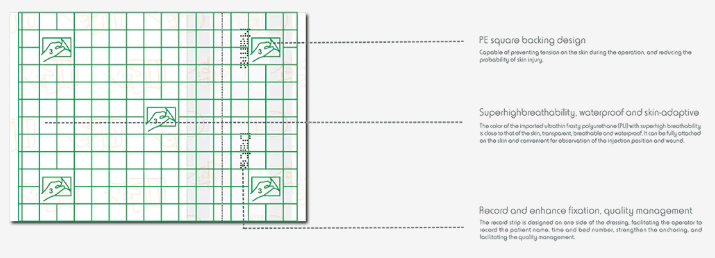
Transparent film dressings are widely used clinically for securing intravenous catheters, covering superficial wounds, and preventing pressure ulcers. However, a complication that is easily overlooked is the formation of tension blisters or avulsion injuries on the skin beneath the dressing. This injury is not due to infection or allergies, but rather mechanical damage caused by the application process itself. The backing of transparent film dressings is a polyurethane film, which itself has no pores. When the dressing is applied to the skin under tension, the film continuously generates a recoil force. This force is transmitted through the adhesive layer to the junction of the epidermis and dermis, and repeated pulling causes the epidermis and dermis to separate, forming serous blisters. Once tension injuries occur, they are more difficult to treat than the primary wound because the damaged area is often equal to the area covered by the dressing. The key to prevention lies entirely in the control of the application technique.
Is skin preparation before applying the patch really that important?
Skin preparation is the foundation for all subsequent procedures; if this step is not done properly, even the best techniques will be difficult to compensate for. The skin surface contains an invisible oil film and shed keratinocytes. If these are not removed, the adhesive cannot form a uniform and firm bond with the stratum corneum. To compensate for insufficient adhesion, operators often subconsciously pull the dressing tighter, which is the starting point for tension damage. The correct approach is to wipe the area to be applied with 75% alcohol or a skin-specific cleansing wipe before application, covering an area slightly larger than the dressing itself. Allow it to completely evaporate and dry before proceeding to the next step. It is recommended to wipe in a unidirectional direction from the center outwards, avoiding back-and-forth wiping which carries oil from the edges to the center. For areas with dense hair, shaving beforehand can avoid pain and follicle damage during removal. However, after shaving, clean away any remaining hair with a damp gauze, as hair left on the skin can form tiny gaps that affect adhesive adhesion. Never apply a mask when your skin feels damp. The moisture trapped under the transparent film can cause the stratum corneum to become overhydrated and fragile, and it may peel off even with slight pulling.
How should dressings be applied correctly?
This is the core operational disagreement that leads to tension injuries. Transparent film dressings inherently possess a certain degree of elasticity and extensibility. This characteristic is designed to allow the dressing to stretch along with the skin at moving areas such as joints, not to be pulled forcefully by the operator during application. The correct technique is to peel the dressing off the release paper and lay it flat on the skin in a completely relaxed state without any tension. First, gently press it into place in the center, then smooth it outwards. When smoothing, use your fingertips to push in one direction from the inside out; do not rub back and forth, and do not stretch the dressing outwards at the edges before applying it. Many operators habitually pinch the two corners of the dressing and pull it taut before covering. This may look smooth and wrinkle-free immediately after application, but the recoil force will continue to act on the skin for several hours. Initially, the patient may only feel tightness, but the damage to the epidermis will become apparent after one or two days. If radial lines are found at the edges of the dressing after application, it means the dressing is too tight and should be removed and reapplied; do not forcibly smooth it by hand.
What are the special requirements for applying transparent film dressings to joints?
The skin around joints has a large range of stretch, and the most common mistake when applying dressings is applying them while the joint is flexed. When applied in a flexed position, the skin is contracted, making the dressing appear loose. However, once the joint returns to an extended position, the skin stretches, pulling the dressing and creating tension. The correct procedure is to first position the joint in a functional or slightly extended position, where the skin is pre-stretched. Then, apply the transparent film dressing without tension, allowing the dressing to stretch and retract synchronously with the skin during joint movement. When applying to recessed areas like the elbow or popliteal fossa, first fill the recess with a small piece of sterile gauze or cotton ball before covering with the transparent film dressing. This prevents shearing forces from creating a gap in the dressing during movement. For large-range joints like the knee and ankle, the stretching capacity of a single transparent film dressing may not be sufficient to handle the skin's stretch. In these cases, use elastic tape at the edge of the dressing where it meets the skin to distribute the tension over a larger area of skin.
Will removing the dressing cause tension injury?
The problem actually stems from improper removal technique. Transparent film dressings adhere very strongly to the skin; directly and quickly tearing them off will peel off the epidermis along with the adhesive. The correct method is to first locate a corner of the dressing, pinch it between your thumb and forefinger, and with the fingers of your other hand, gently stretch the skin at the base of the corner away from the dressing. Then, slowly stretch the dressing at the lowest possible angle, parallel to the skin surface, moving your pressing fingers along the new peel line as you peel. This stretching method utilizes the extensibility of the polyurethane film; stretching and narrowing the film creates stress relaxation between the adhesive and the skin, allowing the dressing to detach naturally rather than tear. If you encounter resistance, do not force it. You can use a cotton swab dipped in a small amount of saline or alcohol to moisten the adhesive surface along the peel line, wait a few seconds, and then continue peeling. If adhesive residue remains on the skin, do not rub it hard with a cotton swab. Use a medical adhesive remover or baby oil to gently rub and dissolve the residue before wiping it clean. Temporary redness after removal is a normal reaction. However, if persistent, patchy erythema or epidermal damage occurs, it's necessary to review the entire application and removal process to identify and improve any steps leading to excessive tension. Skin integrity management is the bottom line of wound care, and every step of applying and removing the transparent film dressing affects the stability of this bottom line. For more information on Innomed®Transparent Dressing Green-Square,refer to the Previous Articles. If you have customized needs, you are welcome to contact us; You Wholeheartedly. At long-term medical, we transform this data by innovating and developing products that make life easier for those who need loving care.
Editor: kiki Jia


