
 English
 عربى
عربى Español
 русский
 中文简体
中文简体






A common problem in stoma care is leakage of excrement into the skin due to improper baseplate adhesion. This leakage irritates the skin, causing redness, swelling, and erosion. The damaged skin surface becomes uneven and the baseplate is harder to adhere, leading to even larger leaks and further skin damage during subsequent changes. Once this cycle begins, it can progress from minor leakage to extensive chemical burns around the stoma in just two or three changes. Breaking this cycle requires understanding the reinforcing mechanism between leakage and skin damage, and then addressing both leakage and skin damage simultaneously, rather than repeatedly trying to fix only one side.
Why can even a small leak cause the skin to break?
The damaging effect of stoma discharge on the skin depends on the type of stoma and the composition of the discharge. Ileostomy discharge contains high concentrations of pancreatic enzymes and bile salts. These digestive active substances are responsible for breaking down proteins and fats in food within the intestines. Once they come into contact with the stratum corneum around the stoma, they directly hydrolyze the desmosomes connecting keratinocytes and intercellular lipids, disrupting the skin barrier rapidly. Clinical observations have shown patients progressing from intact skin to full-thickness epidermal peeling within two to three hours. Colostomy discharge has a lower water content but an extremely high bacterial density. Urea decomposes under the action of bacterial urease to produce ammonia. The alkaline corrosive effect of ammonia also dissolves keratin, and high concentrations of ammonia directly stimulate the sensory nerve endings in the skin. This is why itching often precedes pain in colostomy leakage. Regardless of the stoma type, leakage causes chemical burns to the skin, not ordinary contact dermatitis. Therefore, the urgency and intensity of treatment cannot be treated like a typical skin rash.
Why does the base not stick after the skin is broken?
The adhesion of the adhesive base relies on intermolecular forces and mechanical bonding between the adhesive and a dry, smooth, and intact stratum corneum. When the stratum corneum is eroded and damaged by digestive enzymes and bile salts in excrement, the dense structure of the outermost layer of the epidermis disappears, exposing the underlying moist stratum spinosum and papillary dermis. These layers have high water content and uneven surfaces, making it impossible for the adhesive to establish a stable bonding interface. Simultaneously, the damaged skin continuously exudes tissue fluid, forming a thin liquid film between the adhesive and the skin. This film directly blocks contact between the adhesive and the skin, similar to trying to stick tape on a wet table – it will inevitably not adhere properly. The poor adhesion of the base leads to increased leakage of excrement, allowing more digestive enzymes to contact a larger area of skin, further expanding the skin damage, and consequently reducing the area of intact skin that can be adhered. This creates a self-accelerating cycle.
How can we solve this leakage problem?
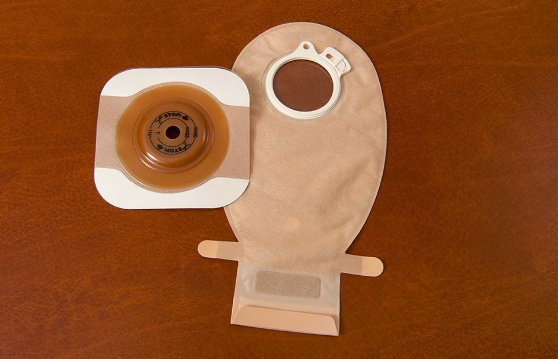
The first step is to accurately measure the actual diameter of the stoma root using a stoma measuring tape. Visual estimation is insufficient, as the stoma shape is often not perfectly circular. It is necessary to measure both the major and minor diameters and then cut the base plate according to the larger diameter. A gap of no more than one millimeter should be maintained between the inner diameter of the cut base plate and the stoma root. This gap is then filled with a leak-proof ring, an alcohol-free, ring-shaped adhesive material that can be directly applied around the stoma root. Upon contact with a small amount of seepage, it slightly expands to seal the gap, physically preventing liquid excrement from contacting the skin. For concave stomas that are flush with or below the skin surface, a standard flat base plate cannot provide an effective seal. A slightly convex base plate must be used instead. The curved structure of the slightly convex base plate applies a slight inward pushing force to the stoma root, causing the stoma to bulge outward. Excrement falls directly into the ostomy bag without lateral leakage towards the inner edge of the base plate. The skin must be completely dry before applying the base plate. After washing, pat the skin dry with a non-woven cloth, and then use a hairdryer on a cool setting for 10 to 15 seconds to ensure there is no residual moisture in the navel area and folds. After applying the base plate, cover it with your palm and press continuously for 3 to 5 minutes. The body heat will soften the adhesive, allowing it to penetrate the skin's texture more fully and form a firm fit.
How can I treat my skin to help it recover to a state where it can be covered up as quickly as possible?
The steps for treating broken skin are: clean and pat dry, then sprinkle a thin layer of stoma skin care powder on the wound. Gently blow away excess powder with sterile gauze, leaving only the layer absorbed on the surface of exudate. The main component of the skin care powder is sodium carboxymethyl cellulose, which absorbs water to form a protective gel film, locking the exudate within the gel and preventing further leakage. A stoma skin protective film is then sprayed on top of the skin care powder. After drying, the liquid protective film forms a transparent film, isolating the skin care powder gel layer and the broken wound from the outside environment, while providing a new, dry, and flat surface for the baseplate to adhere. For deeper erosions, thin sheets of hydrocolloid dressing can be layered on top, forming a second protective layer on the broken skin, with the baseplate then attached on top of the hydrocolloid. The core logic of this layered protection scheme is to replace the baseplate, which would normally be directly applied to the damaged skin, with it applied to a temporarily flat protective surface constructed artificially. Once the damaged skin below has completed epithelialization under the protective film, the intermediate layers are gradually reduced. It's important to note that damaged skin takes time to heal. During this period, the baseplate may need to be replaced more frequently than with healthy skin. This is a necessary time investment to ensure that leakage does not recur. Once the skin has fully healed and returned to its normal thickness, the replacement cycle can be extended again. With simultaneous interventions in both directions, the area of redness and swelling can begin to shrink within one leakage cycle. After several cycles, the cycle can be completely broken, and the condition of the skin around the stoma and the sealing effect of the baseplate return to a mutually reinforcing positive cycle. For more information on Innomed® Skin Protective Powder, refer to the Previous Articles. If you have customized needs, you are welcome to contact us; You Wholeheartedly. At long-term medical, we transform this data by innovating and developing products that make life easier for those who need loving care.
Editor: kiki Jia


