
 English
 عربى
عربى Español
 русский
 中文简体
中文简体






When children bump and bruise themselves while playing, the most agonizing question for parents is whether or not to take them to the hospital for stitches. Stitches help align wound edges, accelerate healing, reduce scarring, and lower the risk of infection, but not all wounds require stitches. The key to determining this lies in the depth, length, location, edge condition, and degree of contamination of the wound. Understanding a few clear criteria can save unnecessary trips and prevent hesitation from causing you to miss the optimal treatment window.
What kind of wounds require stitches at the hospital?
If a wound is a full-thickness tear, revealing yellowish fatty tissue or dark red muscle beneath the skin, even a small wound needs to be closed because the entire skin layer is torn and cannot heal on its own. Wounds longer than 1.2 centimeters (approximately half an inch) usually require stitches; parents can use a ruler to measure if unsure. Wounds that remain visibly open even at rest, preventing the skin from naturally closing, also require suturing. Facial wounds have stricter standards due to aesthetic requirements; wounds exceeding 0.6 centimeters in length require medical evaluation. Bleeding that cannot be stopped by direct pressure for five to ten minutes also requires emergency treatment.
Several types of wounds, regardless of size, require medical attention. Wounds from animal or human bites pose a high risk of infection due to the complex bacterial flora in the mouth, requiring professional debridement and assessment for antibiotics. Puncture wounds from rusty or dirty sharp objects are deep and narrow; while they may appear small on the surface, foreign objects may remain deep inside, creating an anaerobic environment. Wounds with embedded debris such as mud, sand, or pebbles that cannot be removed by flushing are also problematic. Wounds with jagged edges or those that have separated are also dangerous. Wounds involving joints, fingers, or toes, accompanied by numbness or immobility, may indicate nerve or tendon damage. Wounds near the eyes also require specialist treatment.
Which wounds can be treated at home?
Superficial abrasions and scratches, affecting only the epidermis without exposing fat or muscle, with minimal bleeding that stops easily, a length not exceeding 1.2 cm, and wound edges that close naturally without significant opening, usually do not require stitches. Minor cuts, if meeting the above conditions, can also heal on their own with sutureless tape or a simple dressing. The key is that the wound is superficial, without full-thickness lacerations or signs of functional impairment.
What are the correct steps for treating a wound at home?
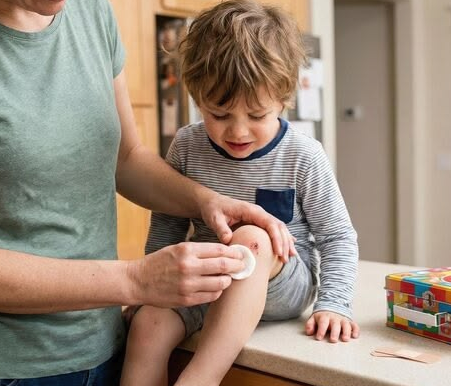
Wash your hands thoroughly before treatment. Apply direct pressure to the wound with clean gauze or cloth for five to ten minutes to stop the bleeding. Do not frequently remove the gauze to check, as this is the most common cause of continued bleeding. Once the bleeding has stopped, wash the wound and surrounding skin with running water and mild soap for at least five minutes. Do not rub the wound vigorously; the purpose is to wash away surface dirt and bacteria. After washing, pat the surrounding skin dry with clean gauze, keeping the wound moist. Apply a thin layer of antibacterial ointment, then cover with dry gauze or a bandage. Change the dressing promptly if it becomes soaked with exudate or soiled, at least once a day.
What signs indicate that a wound has become infected?
If the area of redness and swelling around the wound expands, the skin temperature rises, the pain worsens, or there is purulent discharge or an odor, or red lines extending outward from the wound appear, and the child has a fever or is lethargic, all these symptoms require immediate medical attention. Infections can progress faster in children than in adults, especially wounds on the face and hands; do not wait until symptoms are obvious before seeking treatment.
The principles for treating childhood injuries can be summarized as follows: deep, large, open, dirty, bitten, or numb wounds require immediate medical attention; shallow, small, closed, clean wounds with successful hemostasis can be cared for at home. Home care involves patiently applying pressure to stop bleeding, thoroughly rinsing the wound, covering it to maintain cleanliness, and observing for infection. If the cause is unclear, it's better to make an extra trip to the hospital than to let a wound that could have healed successfully become infected or develop a scar due to delay. For more information on Innomed® Silicone Foam Dressing, refer to the Previous Articles. If you have customized needs, you are welcome to contact us; You Wholeheartedly. At longterm medical, we transform this data by Innovating and Developing Products that Make Life easier for those who need loving care.
Editor: kiki Jia


