
 English
 عربى
عربى Español
 русский
 中文简体
中文简体






When we were kids, we'd scrape our knees, and after a few days, a dark brown scab would form. Adults would say it would heal once the scab fell off. This experience has been passed down for generations, to the point that most people feel reassured when they see a scab forming on a wound. However, modern wound care research has concluded the opposite: scab formation is not an accelerator for wound healing; rather, it's a process that should be avoided as much as possible.
Why is it said that scabbing over a wound can actually hinder recovery?
A scab is essentially a solid mass formed by the dehydration of fibrin, platelets, and exuded tissue fluid from the blood in the air. This hard shell does cover the wound, temporarily blocking dust and some bacteria. However, the problem is that the healing process beneath the scab is not smooth. Epidermal cells need to move from the wound edges towards the center, requiring movement on a moist surface. Encountering a dry, hard scab is like hitting a wall; they either stop or detour around the scab's edge. As a result, exudate repeatedly flows from the wound edges, the scab piles up thicker and thicker, and the space underneath fails to heal properly.
Another problem is oxygen deprivation and suffocation. The scab completely seals the wound, preventing oxygen from entering. Granulation tissue growth and collagen synthesis both depend on oxygen, and these processes are significantly slowed down in an anaerobic environment. More importantly, some dangerous bacteria thrive in oxygen-free environments, such as Clostridium tetani. While the surface may appear to be a solid, black scab, there are often tiny gaps between the scab and the wound, allowing bacteria to multiply undetected. By the time the scab is removed, a pool of pus may have already accumulated underneath. Clinically, I've seen far too many cases like this: superficial abrasions that should heal in two weeks take one or two months to heal due to repeated thick scab formation.
What kind of wounds are most afraid of scabbing?
Not all scabs are a problem. Very superficial abrasions, with only minor damage to the epidermis and no impact on the dermis, will typically develop a thin scab that naturally peels off after a few days, allowing new epithelium to grow underneath. In such cases, it can be left alone. What's concerning are wounds that reach the dermis, where a reddish base or a few pinpoint hemorrhages are visible. These wounds have lost their entire epidermis and must rely on epithelial cells to spread from the edges towards the center to cover the wound. The ideal environment for this process is moist but not waterlogged; dry scabs block this pathway. Ruptured blisters after a burn are another typical example. Many people believe burns should be allowed to dry and scab over, but in reality, dermal damage from a burn requires a moist environment to protect the remaining hair follicles and sebaceous gland epithelium. These epithelial structures are crucial for healing; dry scabs cause them to dehydrate and die. Deep second-degree burns heal one to two weeks faster with a moist wound treatment than with a dry, exposed wound treatment, resulting in smoother scars.
How to use functional dressings to prevent scabbing?
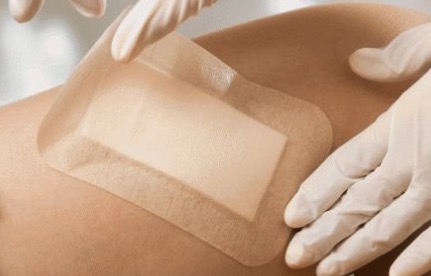
Modern wound care has a well-established system to replace dry scabs, with various functional wound dressings at its core. These products are specifically designed to keep the wound moist while preventing it from being soaked in water. Hydrocolloid dressings are the most convenient option for treating superficial abrasions and cuts. Their components include sodium carboxymethyl cellulose and elastomers. After being applied to the wound, the inner layer absorbs a small amount of exudate, forming a soft gel. This gel directly covers the wound surface, neither drying nor flowing, allowing newly formed epithelial cells to move smoothly along the wound base beneath the gel. The application is simple: rinse the wound with saline solution to remove surface dirt and blood clots, and dry the skin around the wound. Select a hydrocolloid dressing that is two to three centimeters larger than the wound, peel off the protective film, and apply it directly. Gently press the edges with your palm for thirty seconds to ensure the dressing adheres completely to the skin. Leave it on for three to five days without needing to change it. The standard for determining when to change the dressing is to observe the surface. If the central area is noticeably bulging and whitened, it indicates significant absorption of exudate, but as long as there is no leakage, it doesn't need to be addressed. Wait until the edges of the dressing start to curl up or a large white bump appears before peeling it off. Underneath, there is usually pink new epithelium with no trace of scab.
Besides applying dressings, what else needs to be done?
Preventing scab formation requires more than just a dressing; several complementary measures can improve the success rate. Wound cleaning is the easiest area to go wrong with. Many people habitually disinfect wounds with iodine or alcohol before applying a dressing, which is unnecessary and even harmful for fresh, clean wounds. Disinfectants can damage exposed fibroblasts on the wound surface, actually slowing down healing. The correct approach is to simply rinse away dirt and blood clots with saline solution. If the wound is contaminated with dirt or other visibly foul-smelling substances, first rinse thoroughly with saline solution, then gently wipe with iodine, rinse off the iodine with saline solution again, and finally apply a dressing. The frequency of observation also needs to be adjusted.
For more information on Innomed® Hydrocolloid Dressing, refer to the Previous Articles. If you have customized needs, you are welcome to contact us; You Wholeheartedly. At long-term medical, we transform this data by innovating and developing products that make life easier for those who need loving care.
Editor: kiki Jia


