
 English
 عربى
عربى Español
 русский
 中文简体
中文简体






The treatment of wounds in pets due to fighting, external injuries, or surgery differs significantly from that in humans, with dressing selection being a crucial factor in determining healing quality. A pet's activity level, fur coverage, and tendency to chew on the dressing all directly influence how the dressing is secured and how frequently it needs to be changed. Clinically, dressing selection for dogs and cats is primarily based on three dimensions: wound moisture, exudate volume, and infection risk. However, in practice, the most commonly used and basic combination is gauze with a self-adhesive bandage. While this combination seems simple, there are clear guidelines and precautions for its use in practice.
As a primary dressing for contacting wounds, the material and number of layers of gauze need to be adjusted according to the type of wound. Ordinary sterile gauze, woven from cotton fibers, has good absorbency and breathability, is inexpensive and readily available, and is a basic component of pet first-aid kits. For clean, dry wounds or wounds with only a small amount of exudate, four to six layers of gauze folded to an appropriate size can cover the wound. Its capillary action can absorb a small amount of exudate and keep the wound relatively dry. The fiber structure of the gauze does not strongly adhere to the wound when dry, and it can usually be easily removed during dressing changes. However, for wounds with significant exudate or granulation tissue growth, ordinary gauze has a clear drawback: after the exudate dries, the fibers and new tissue can become physically interlocked. Tearing during dressing changes can easily remove the new epithelium and granulation tissue, causing secondary damage and bleeding. In such cases, a layer of petroleum jelly gauze or oily mesh can be added between the gauze and the wound as a separating layer, or a non-adhesive dressing can be used instead. If the above materials are not available, you can also soak gauze in saline solution before covering the wound. Wet gauze is less adhesive than dry gauze, but wet gauze will accelerate moisture evaporation, so a waterproof material needs to be applied to the outside to prevent it from drying out too quickly.
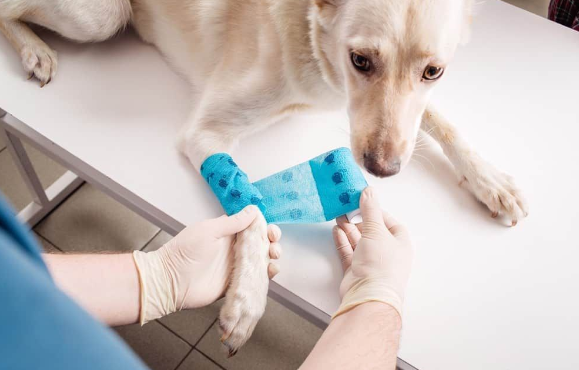
Self-adhesive bandages are the core material for outer layer fixation. They are made of elastic non-woven fabric or cotton cloth coated with a self-adhesive adhesive, allowing for easy wrapping and securing without additional tape or pins. The biggest advantage of self-adhesive bandages is that they only adhere to their own adhesive surface, not the pet's fur. Removing them avoids skin irritation and struggle caused by pulling hair. This characteristic significantly distinguishes them from ordinary medical tape, which adheres to furry skin, and the pain of removal can cause dogs and cats to develop a fear of dressing changes, making subsequent dressing changes more difficult. When using self-adhesive bandages, wrapping should start from the distal end of the limb and work towards the proximal end, with each wrap covering half the width of the previous one to provide even pressure distribution. The tightness of the wrapping needs precise control: too tight, and it will compress blood vessels, affecting distal blood supply, manifesting as purple discoloration of the paw pads and decreased skin temperature; too loose, and the dressing will easily slip off, becoming loose after the pet moves around for a few minutes. Taking a dog's forelimb as an example, the standard for wrapping is that one finger can be easily inserted. After wrapping, the end of the bandage can be folded back and wrapped again, and the end can be fixed with self-adhesive. There is no need to use metal clips or tape for fixation.
So, what types of pet wounds are suitable for gauze and self-adhesive bandages?
This combination is suitable for clean lacerations, closed postoperative incisions, and superficial ulcers with moderate exudate after debridement. For wounds with extremely high exudate, the gauze's absorbency may be insufficient, and the exudate will quickly soak through the gauze and saturate the surrounding skin. In this case, it is necessary to increase the number of gauze layers or use a highly absorbent dressing. For wounds that are heavily contaminated or contain necrotic tissue, gauze itself does not have antibacterial or debridement functions and must be used in conjunction with antibacterial gauze containing iodine or silver. Ordinary gauze alone cannot control infection. For wounds located on the trunk or head, self-adhesive bandages are difficult to form an effective wrapping and fixation. Medical elastic mesh or surgical gowns can be used in conjunction. Regarding the frequency of dressing changes, the combination of gauze and self-adhesive bandages usually needs to be changed once a day. If the exudate is low, this can be extended to once every two days. If the dressing is not changed for more than two days, the dried exudate will significantly increase the adhesion between the gauze and the wound. When removing the bandage, use scissors to carefully cut along one side of the bandage, ensuring that the tip of the scissors is parallel to the skin surface to avoid pricking the pet. If the gauze is found to be tightly adhered to the wound and cannot be separated, do not forcibly tear it off. Instead, moisten the adhered area with saline solution and wait several minutes until a scab forms or the exudate dries and softens before attempting to remove it. For chronic wounds requiring long-term dressing changes, a layer of cotton or a soft pad can be wrapped around the gauze, and then secured with a self-adhesive bandage to increase cushioning and reduce the dressing's impact on the wound during pet activity . For more information on Innomed® Elastic Bandage For Pet , refer to the Previous Articles. If you have customized needs, you are welcome to contact us; You Wholeheartedly. At long-term medical, we transform this data by innovating and developing products that make life easier for those who need loving care.
Editor: kiki Jia


