
 English
 عربى
عربى Español
 русский
 中文简体
中文简体






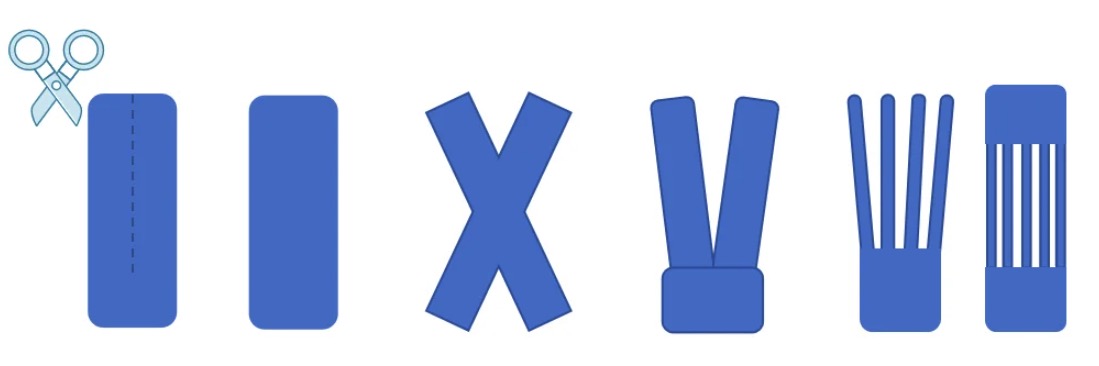
For wounds on joints like fingers, knees, and elbows, the problem of dressings curling up or falling off after only half a day is a common headache. If applied vertically, the dressing stretches open when the joint is bent; if applied horizontally, the edges peel up after a few movements. Actually, there's a simple method that doesn't require more expensive dressings or multiple layers of bandage; simply change the shape of the dressing—cut it into an X shape.
Why do regular stickers tend to fall off easily?
The skin around joints stretches, contracts, and twists during movement. If a dressing is applied vertically, the middle is stretched and the ends are pulled when the joint bends, causing the edges to curl up. If applied horizontally around the joint, the dressing experiences uneven tension on both sides during joint movement, with one side loose and the other tight, causing the looser side to curl up quickly. The root of the problem is that the dressing does not distribute stress evenly with the deformation of the skin. The X-shaped application method is designed to address this issue.
How exactly do you apply the X-shaped method?
Prepare a dressing large enough, such as a foam dressing or hydrocolloid dressing, that is slightly larger than the wound. Using sterilized scissors, cut four slits from the center of each of the four sides of the dressing towards the center, each slit being approximately one-third to one-half the width of the dressing. After cutting, the dressing will look like four petals connected in the middle, forming an X shape. Align the center of the dressing with the wound and secure it in the middle. Then, pull the four petals apart in four directions and apply them to the top, bottom, left, and right sides of the joint. The X shape for finger joints can be cut smaller, and the X shape for knee joints can be cut larger.
After applying the dressing, move your joints a little. You'll find that the dressing stretches with the skin instead of being forcibly pulled apart. Because the four flaps bear the force independently, the tension in each direction is distributed, and the edges are less likely to lift up.
Why does an X-shape adhere three times more firmly than a vertical one?
A simple tensile test was conducted for comparison. Dressings of the same size, applied to a curved surface simulating joint movement, showed that the vertically applied dressing began to curl at the edges after 30 movements and detached after 50 movements. The X-shaped application, however, remained well-adhered after 150 movements, demonstrating approximately three times the stability of the vertically applied dressing. The principle behind this is that the X-shape breaks down the dressing into four independent movable segments, each bearing the tensile force in only one direction, rather than the entire dressing bearing forces from all directions. Furthermore, the four segments alternately cover each other, forming multiple anchor points; if any segment curls up, the other three can maintain overall stability.
Which body parts are suitable for the X-shaped method?
For finger and toe joints, with wounds on the back or pad of the finger, the X-shaped method of applying small dressings is very effective. For wrists and ankles, where there is a large range of motion, ordinary dressings won't last more than half a day; the X-shaped method, combined with a self-adhesive elastic bandage for outer fixation, can last for one or two days. For elbows and knees, where the range of motion is greatest, the X-shaped method requires deeper incisions, with the four segments being more than half the diameter of the dressing. The X-shaped method is also suitable for irregular curved surfaces like the heel and armpit.
Precautions for using the X-shape method
When making the cut, do not cut directly above the wound. The cut should be outside the wound area, only cutting the edge of the dressing. If the dressing itself is very small, such as the size of a band-aid, and you cannot cut four pieces, you can use two pieces of dressing crossed over each other to achieve a similar effect. Apply the dressing while the joint is in a neutral position, for example, straighten the leg when applying to the knee, and slightly bend the arm when applying to the elbow. If the wound is inside the flexural surface of the joint, such as the fingertip, the four pieces of the X-shaped method can be shortened appropriately to avoid overlapping and rubbing during movement.
What dressings can be used with the X-shaped method?
Foam dressings are most suitable; they are soft and elastic, and the edges don't curl easily after being cut. Hydrocolloid dressings can also be used, but they are relatively thin, so be careful not to tear them when cutting. Silicone dressings are also suitable; their self-adhesive properties combined with the X-shaped structure provide better fixation. Ordinary gauze dressings are not suitable for making X-shapes; they are too soft and won't maintain their shape after being cut. Transparent film dressings are too thin and soft and easily tear when cut, so this method is not recommended.
Dressings on joints often fall off, not because of poor quality, but because of incorrect application. The X-shaped method involves cutting the four sides of the dressing, creating four independent, movable flaps that distribute the tension generated by joint movement. It's simple to do, requiring only a pair of scissors, and is about three times more secure than applying it vertically. Next time you apply dressings to your fingers, knees, or elbows, try this method; you'll find the dressing stays put all day. For more information on Innomed®Sports Bandage Cotton, refer to the Previous Articles. If you have customized needs, you are welcome to contact us; You Wholeheartedly. At long-term medical, we transform this data by innovating and developing products that make life easier for those who need loving care.
Editor: kiki Jia


