
 English
 عربى
عربى Español
 русский
 中文简体
中文简体






After an abscess is incised and drained, an open wound with neat edges but a clearly visible internal cavity remains. Faced with this cavity, many patients and their families' first reaction is to question why it wasn't sutured, or to believe that leaving it open to allow the pus to drain naturally is sufficient. Both of these approaches are incorrect in the management of infected wounds. Direct suturing means sealing a large number of bacteria, necrotic tissue fragments, and inflammatory exudate into a closed, dead cavity. The sutures provide a surface for foreign bodies to attach, allowing bacteria to multiply rapidly in an anaerobic environment. Within hours, the sutured opening can turn into a larger abscess, causing the patient to experience more severe redness, swelling, heat, pain, and systemic fever than before the incision. Leaving it open goes to the other extreme. The healing speed of a skin incision is usually faster than the rate at which granulation tissue fills the deep cavity from the bottom up. The external opening may narrow or even close within a few days due to the migration of peripheral epithelial cells. Bacteria and exudate within the deep cavity are trapped under the closed skin and continue to multiply, forming a chronic sinus tract or a recurring deep abscess. The fundamental purpose of packing dressings is to prevent these two extreme situations from occurring, giving deep tissues time to gradually grow from the bottom up.
What role do the packing dressings play in the cavity?
Packing is not simply stuffing gauze into a cavity to drain pus; its mechanism of action within an infected cavity is a multi-functional system operating simultaneously. The first function is drainage. The packing material creates countless tiny capillary channels within the cavity, continuously draining deep inflammatory exudate along these channels to the external opening, where it is received by the outer dressing. This prevents the accumulation of fluid pressure within the cavity, and the bacterial density gradually decreases as the exudate is continuously carried away. The second function is space occupation. The packing physically prevents the skin at the external opening edge from collapsing inward and closing. The packing keeps the external opening edge open, maintaining communication with the bottom of the cavity. Healing can only begin from the deepest basal granulation tissue, filling upwards layer by layer. As the granulation tissue grows upwards, the packing gradually exits the cavity; this process is clinically termed inside-out healing. The third function is to provide a complete removal debridement for subsequent dressing changes. Each time the packing dressing is changed, the necrotic tissue debris and bacterial clumps that fall off inside the cavity will be attached to the surface of the dressing and carried out together. This is equivalent to completing a minor non-surgical debridement with each dressing change. This function has continuous value in reducing bacterial load and necrotic tissue residue.
Why use alginate dressings for packing?
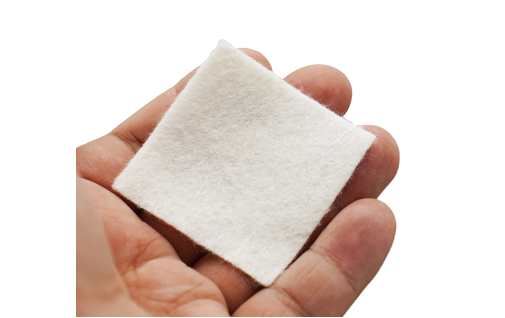
Ordinary gauze packing has several insurmountable drawbacks, which are precisely what must be absolutely avoided in the treatment of infected cavities. Gauze is made of short fibers, and during packing and removal, a large amount of fiber debris detaches and remains deep within the cavity. These tiny foreign objects become the nucleus for bacterial attachment, forming microabscesses around them, a major cause of persistent and recurrent infections. After absorbing fluid, the gauze diffuses outwards along the fiber gaps instead of being locked within the fibers. While the fluid is being drained, it also seeps back into the cavity wall and surrounding tissues, exacerbating maceration and edema of the surrounding normal tissues. When the gauze dries and hardens, pulling the hardened gauze out of the cavity during the next packing can tear the tender granulation tissue growing on the cavity wall, causing bleeding and pain. This pain, in turn, makes patients resist proper packing, creating a negative feedback loop where inadequate packing leads to poor infection control. Alginate dressing strips and hydrocolloid fiber strips are materials specifically designed for cavity packing. Alginate fibers gel through calcium and sodium ion exchange upon contact with exudate, while hydrocolloid fibers absorb water and swell to form a continuous gel. Both effectively trap exudate within the fiber network, preventing backflow. During dressing changes, they can be removed completely without leaving fiber debris. If resistance is encountered during removal, moistening with saline solution for a few seconds will loosen the dressing without tearing granulation tissue. This material-level difference transforms cavity packing from a single traumatic procedure with each dressing change into a smooth, repeatable process.
What are the proper procedures for tamping?
Packing requires several fixed steps, and the details of each step affect the final healing speed. First, thoroughly flush the cavity with saline solution. Use a flushing syringe or indwelling needle tubing to deliver the flushing solution to the bottom of the cavity. The flushing solution will overflow from the cavity opening, carrying away any exudate and necrotic debris accumulated since the previous packing. Repeat flushing until the overflowing liquid is no longer cloudy. After flushing, use sterile gauze rolled into a thin strip to pat dry the skin around the cavity opening, but do not insert the gauze into the cavity to absorb the dryness. A small amount of residual flushing solution inside the cavity will not affect the packing effect and will instead prevent the dressing from drying and sticking. When packing, take an appropriate amount of alginate or hydrocolloid fiber strip, hold one end with sterile forceps, and insert it along the natural direction of the cavity. After the forceps reach the bottom of the cavity, release the dressing, allowing it to naturally adhere to the inner wall of the cavity. The appropriate amount of packing is enough to lightly touch the bottom of the cavity with a small amount of the dressing tail remaining at the outer opening. It is not necessary to apply layers of pressure tightly; over-packing will compress the blood supply to the cavity wall, slowing granulation tissue growth. Leave about one centimeter of the dressing tip outside the cavity opening for easy removal during the next dressing change. Do not push the dressing completely into the cavity without leaving a tip. Cover with a foam dressing or a thick gauze pad to catch the drained exudate. The dressing change frequency depends on the amount of exudate. During the acute phase of infection, when the exudate volume is large, the cavity packing dressing is usually changed once or twice daily. Do not extend the interval due to pain during dressing changes. If exudate accumulates in the cavity without a new packing dressing, the drainage channel will be blocked by crusts, leading to poor drainage and stagnation or even regression in infection control. For more information on Innomed® Alginate Dressing Rope, refer to the Previous Articles. If you have customized needs, you are welcome to contact us; You Wholeheartedly. At long-term medical, we transform this data by innovating and developing products that make life easier for those who need loving care.
Editor: kiki Jia


